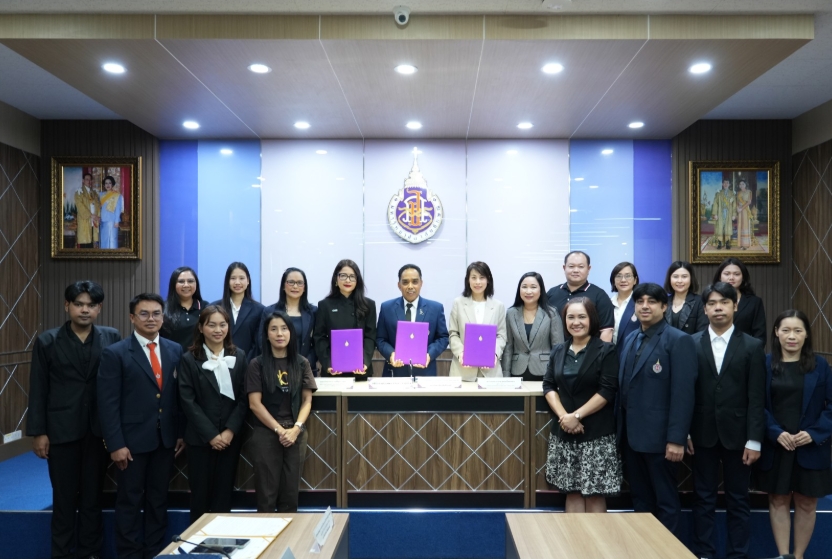
Walailak University, GGC, and GIZ Join Forces to Empower Students to Support Farmers and Advance Thailand’s Palm Oil Industry toward a Low-Carbon Future.
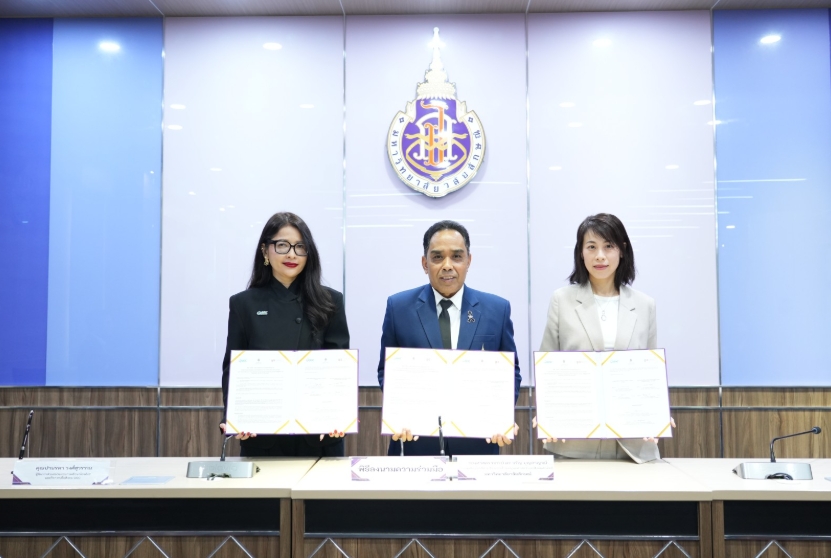
Walailak University (WU), through its School of Accountancy and Finance, has partnered with Global Green Chemicals Public Company Limited (GGC) and Deutsche Gesellschaft für Internationale Zusammenarbeit (GIZ) GmbH in Thailand to continue the “Youth–Farmer Collaboration Initiative for Sustainable and Low-Carbon Oil Palm Production.”
The initiative is being implemented under the Sustainable Palm Oil Production and Procurement for Climate Change Mitigation (SPOPP CLIMA) project. It aims to harness the potential of young people to support smallholder farmers in producing low-carbon oil palm while enhancing the competitiveness of Thailand’s palm oil industry in the global market.
A Letter of Intent was signed on 16 July 2026 by Associate Professor Dr. Charan Boonkan, Vice President for Academic Affairs in Humanities and Social Sciences at Walailak University; Ms. Panrada Wongsuwan, Corporate Branding and Social Affairs Section Manager at GGC; and Dr. Kanokwan Saswattecha, Project Director of SPOPP CLIMA at GIZ.
The signing ceremony was witnessed by Assistant Professor Dr. Neeranat Kaewprasert Rakhangthong, Acting Dean of the School of Accountancy and Finance; Assistant Professor Dr. Somjai Noopung, Head of the School’s Research Center and project leader; and executives from the three partner organizations. The ceremony was held at the Khao Luang Meeting Room, Cooperative Education Building, Walailak University.
The initiative serves as a pilot project for establishing an “Intergenerational Co-Learning Space,” connecting young people and farmers so they can exchange theoretical knowledge, technology, and practical experience. By complementing one another’s strengths, they can help drive oil palm production toward long-term sustainability and lower carbon emissions.
The project also seeks to inspire young people to take a greater interest in and develop a deeper understanding of the agricultural sector. In the long term, it may encourage them to return home and take over their families’ oil palm plantations with a new approach that integrates knowledge, technology, and sustainability.
Associate Professor Dr. Charan Boonkan stated that Walailak University is committed to producing graduates who can contribute to achieving the Sustainable Development Goals. This partnership provides students—particularly those from the School of Accountancy and Finance—with opportunities to apply their knowledge in real-world settings.
“Education today must not be confined to the classroom. We aim to develop graduates who can think analytically, plan effectively, and understand global environmental challenges so they can create innovations and deliver sustainable benefits to communities,” he said.
Ms. Panrada Wongsuwan explained that GGC places great importance on conducting business alongside sustainable development by balancing economic, social, and environmental considerations. The company believes that developing people through education is a fundamental foundation for long-term sustainability.
This collaboration therefore connects academic knowledge with practical application, preparing a new generation with the capabilities needed to create shared value among businesses, communities, and society—an essential foundation for Thailand’s sustainable development.
Dr. Kanokwan Saswattecha of GIZ Thailand added that although Thailand’s oil palm industry is the third largest in the world, it faces challenges arising from an ageing farming population with limited access to technology.
The SPOPP CLIMA project therefore seeks to empower young people to serve as intermediaries who can transfer modern knowledge and skills to the agricultural sector. The project aims to help students understand that an oil palm plantation is not merely a cultivation area but also a stable and sustainable agribusiness.
Strengthening the upstream sector will ultimately contribute to greater sustainability throughout the entire supply chain.
Source: Walailak University website